Waterproof Gold Jewelry in Canada: What Actually Lasts
In this guide
Only two types of gold jewelry are genuinely waterproof in Canadian daily wear: solid gold (10K and above) and 18K gold plated 316L stainless steel made with PVD bonding. Gold vermeil, gold filled, and traditional electroplated jewelry are water-resistant at best — they survive occasional splashes but degrade with repeated exposure to chlorine, hot tubs, sweat, and sunscreen. The marketing word *waterproof* gets used loosely. This guide breaks down what it actually means at the material level, which scenarios each material survives, and which Canadian-specific conditions (winter road salt, coastal humidity, -30°C cold) most US-focused guides ignore.
Waterproof vs Water-Resistant — What the Label Actually Means
Canadian retailers throw around *waterproof*, *water-resistant*, *non-tarnish*, and *tarnish-free* almost interchangeably. They are not the same thing. Under Canada's Competition Act, product claims must be substantiated — but there's no fixed industry definition of what makes jewelry *waterproof* in practice, so brands set their own bar.
Functionally, jewelry sits on a spectrum. Waterproof means the piece can be fully immersed repeatedly with no measurable degradation — solid 14K gold, marine-grade titanium, and quality PVD-plated 316L stainless steel sit here. Water-resistant means brief or occasional contact is fine, but repeated immersion accelerates wear — gold vermeil, gold filled, and most electroplated jewelry sit here. Tarnish-free is a separate axis entirely: it refers to surface oxidation under normal air, not water survival. A piece can be tarnish-free in your jewelry box but still fail in a hot tub.
The practical implication: read the brand's own wear guidance, not the headline keyword. A piece marketed as *waterproof* that explicitly tells you to remove it before swimming is a water-resistant piece with aspirational copy.
The Honest Test Matrix — Material vs Scenario
This is the comparison table no other Canadian guide includes. Seven common jewelry constructions across eight real-world wet-exposure scenarios. Pass means routine exposure is fine. Caution means occasional is OK but daily repetition shortens lifespan. Avoid means the exposure causes measurable damage within weeks.
| Scenario | Solid 14K-18K Gold | Gold Filled | Gold Vermeil | PVD 18K Plated 316L (Glozya) | Electroplated Brass | Sterling Silver | Pure 316L Stainless |
|---|---|---|---|---|---|---|---|
| Shower (shampoo, soap) | Pass | Pass | Caution | Pass | Avoid | Caution | Pass |
| Chlorinated pool | Pass | Caution | Avoid | Pass | Avoid | Avoid | Pass |
| Hot tub (38°C+ chlorine) | Caution | Avoid | Avoid | Caution | Avoid | Avoid | Caution |
| Saltwater (ocean) | Pass | Caution | Avoid | Pass | Avoid | Avoid | Pass |
| Sweat / gym | Pass | Pass | Caution | Pass | Avoid | Caution | Pass |
| Sunscreen / lotion | Pass | Caution | Caution | Caution | Avoid | Caution | Pass |
| Hand sanitizer (70% alcohol) | Pass | Caution | Avoid | Caution | Avoid | Caution | Pass |
| Canadian winter road salt | Pass | Caution | Avoid | Pass | Avoid | Caution | Pass |
Two things stand out. First, solid gold and quality PVD-plated 316L stainless steel are the only two constructions that pass cleanly across the realistic everyday-wear scenarios. Second, hot tubs are uniquely brutal — even materials that survive everything else slide into caution territory because of the chlorine concentration and elevated temperature combined.
Is Solid Gold Actually Waterproof?
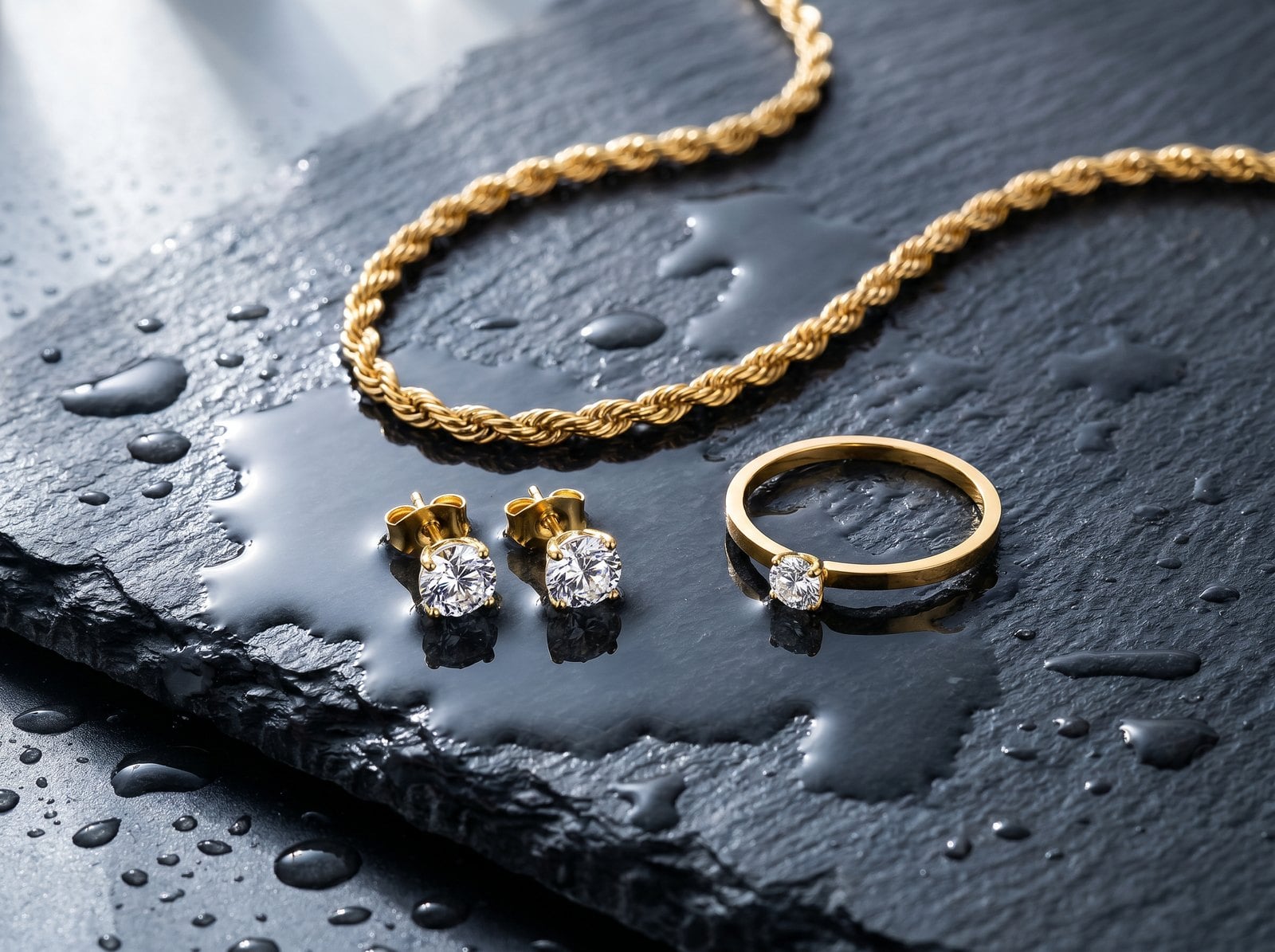
Yes — gold itself is one of the most chemically inert metals on the periodic table. It does not react with water, oxygen, or most household chemicals. That's why archeological gold from shipwrecks emerges intact after centuries underwater. The complication is that solid gold jewelry is never 100% gold (24K is too soft to wear); it's alloyed with other metals for hardness and color, and those alloys behave differently.
Karat-by-Karat: 10K, 14K, 18K, 24K
- 24K gold (99.9% pure) — Completely inert; never tarnishes, never reacts. But too soft for rings or bracelets that take impact. Mostly used in bullion and ceremonial pieces.
- 18K gold (75% pure) — The benchmark for fine jewelry. The 25% alloy (typically copper and silver) can develop very faint patina over decades, but for everyday wet exposure it's effectively waterproof.
- 14K gold (58.3% pure) — The most common fine-jewelry karat in North America. Hard enough for daily wear, low enough alloy content that water-related tarnish is rare. Per the GIA's gold quality factor, 14K is the practical sweet spot for durability + appearance.
- 10K gold (41.7% pure) — The minimum karat that can legally be called *gold* in Canada and the US. Higher alloy content means a slightly higher chance of subtle reactivity in chlorine, but it's still waterproof for everyday wear.
The catch with solid gold isn't the gold — it's the non-gold components. Settings, prongs, clasps, and gemstones can all fail in water. Pearl strands should never go in a shower (the porous nacre absorbs soap residue). Pavé settings can loosen over years of repeated wet-dry cycles. The metal is waterproof; the piece may not be.
Gold Plated, Vermeil, and Gold Filled — Side by Side
Three terms get mixed up constantly in marketing copy. The actual technical differences between gold plated, gold filled, and solid gold come down to how much gold is bonded to the base metal and how it's applied.
- Gold plated — A thin layer of gold (commonly 0.5 to 2.5 microns) deposited onto a base metal via electroplating. Survives gentle wear but the layer is thin enough that repeated chemical exposure wears through within months on cheap pieces.
- Gold vermeil — A specific type of gold plating with two requirements: the base must be sterling silver, and the gold layer must be at least 2.5 microns thick and 10K minimum. More premium than standard plating but still wears through with frequent water exposure.
- Gold filled — A mechanically bonded layer of gold (legally must be at least 5% of the piece's weight) pressure-bonded to a base metal core. Far more durable than plating; survives daily wear and most water exposure for 10-20 years.
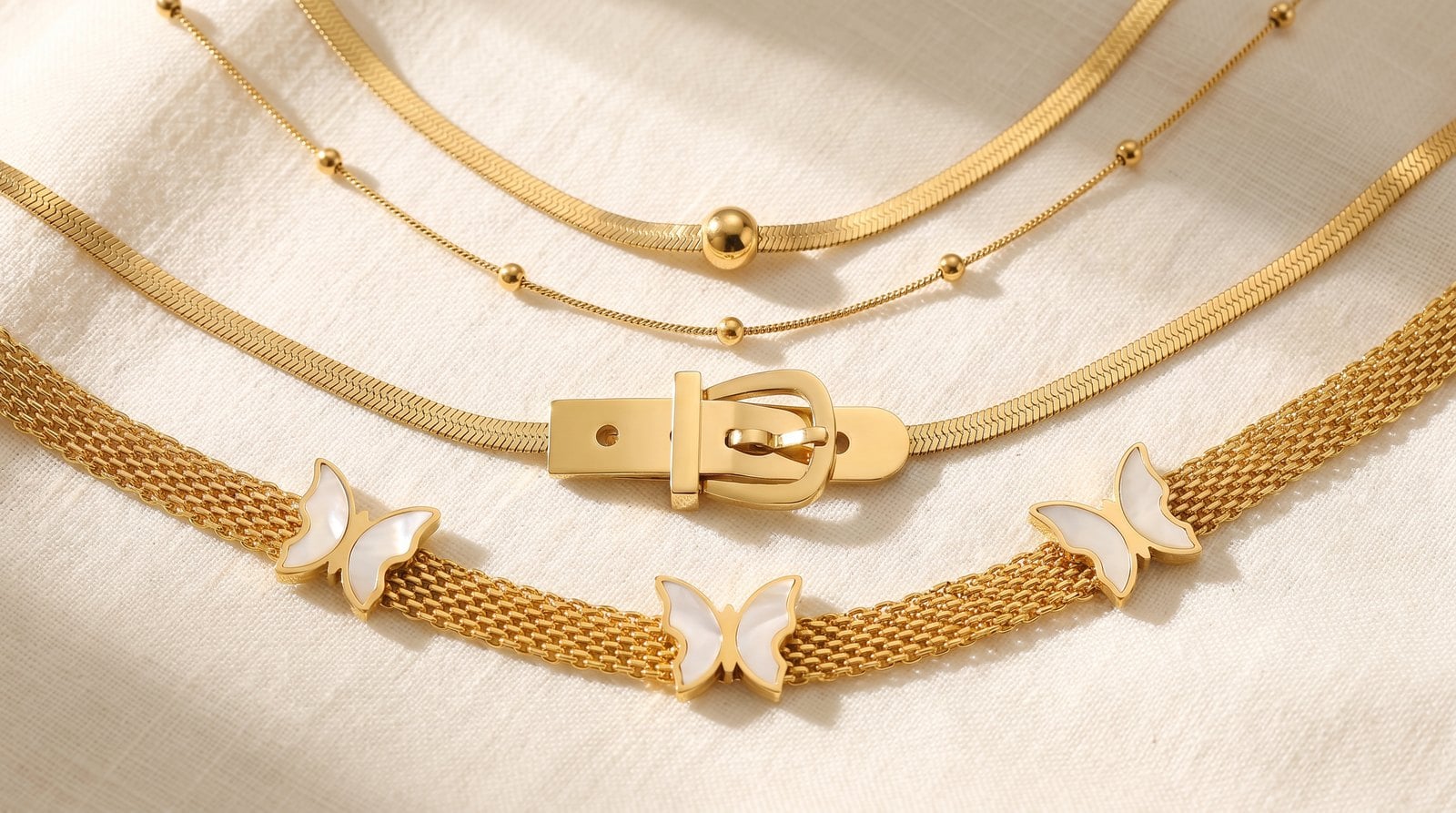
Plated and vermeil pieces are the riskiest waterproof candidates because the failure mode is invisible until it isn't. The piece looks fine, then one day you notice the underlying brass coming through at a wear point. Gold filled is a better long-term value for daily-water wearers but tends to cost three to five times what plated pieces do.
What PVD Gold Plating Is and Why It Survives Water
PVD stands for Physical Vapor Deposition — a vacuum-chamber process used in aerospace and surgical-tool manufacturing long before it reached jewelry. Inside the chamber, gold is heated until it vaporizes, then deposited onto the base metal at a molecular level. The bond isn't a coating sitting on top; it's a fused atomic interface between the gold layer and the steel substrate.
The reason this matters for waterproofing: electroplated gold sits on the base metal as a separate layer. Water and chemicals attack the boundary between the two. PVD gold bonds atomically with the substrate, so there's no clean interface for water to attack. Combined with a 316L stainless steel base (which is itself inert to water and chlorine), the resulting piece behaves more like solid gold than like plated jewelry.
Plating bond
Molecular
PVD vapor bonds atomically with the steel base, unlike electroplating which deposits as a separate layer that water can penetrate.
Plating thickness
2.5+ microns
Quality PVD jewelry uses 2.5+ microns of 18K gold, well above the 0.5 micron flash plating found on cheap costume pieces.
Daily-wear lifespan
2-3+ years
PVD 18K on 316L typically retains color through 2-3 years of daily wear including showers, vs 3-6 months for brass-based electroplating.
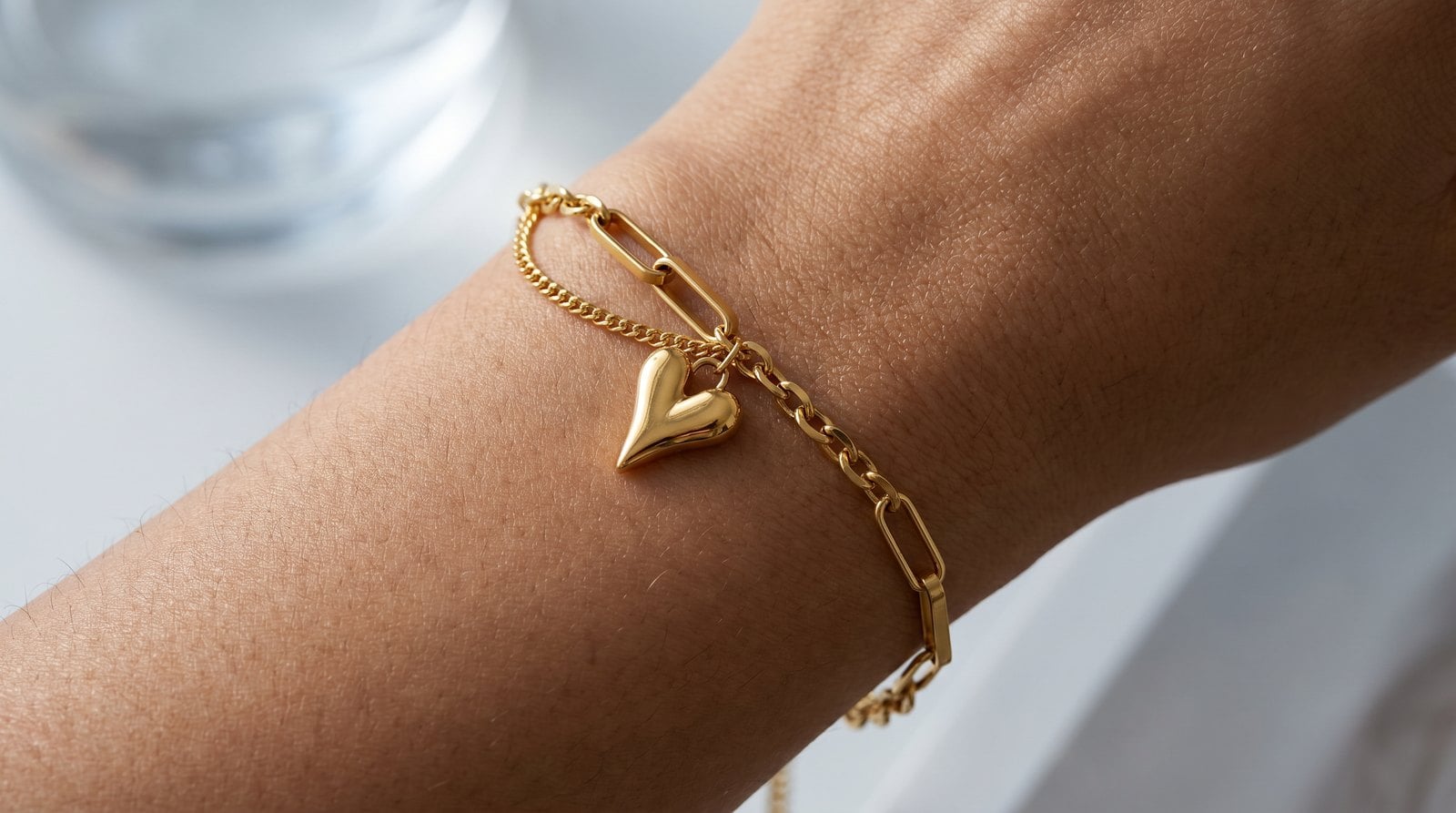
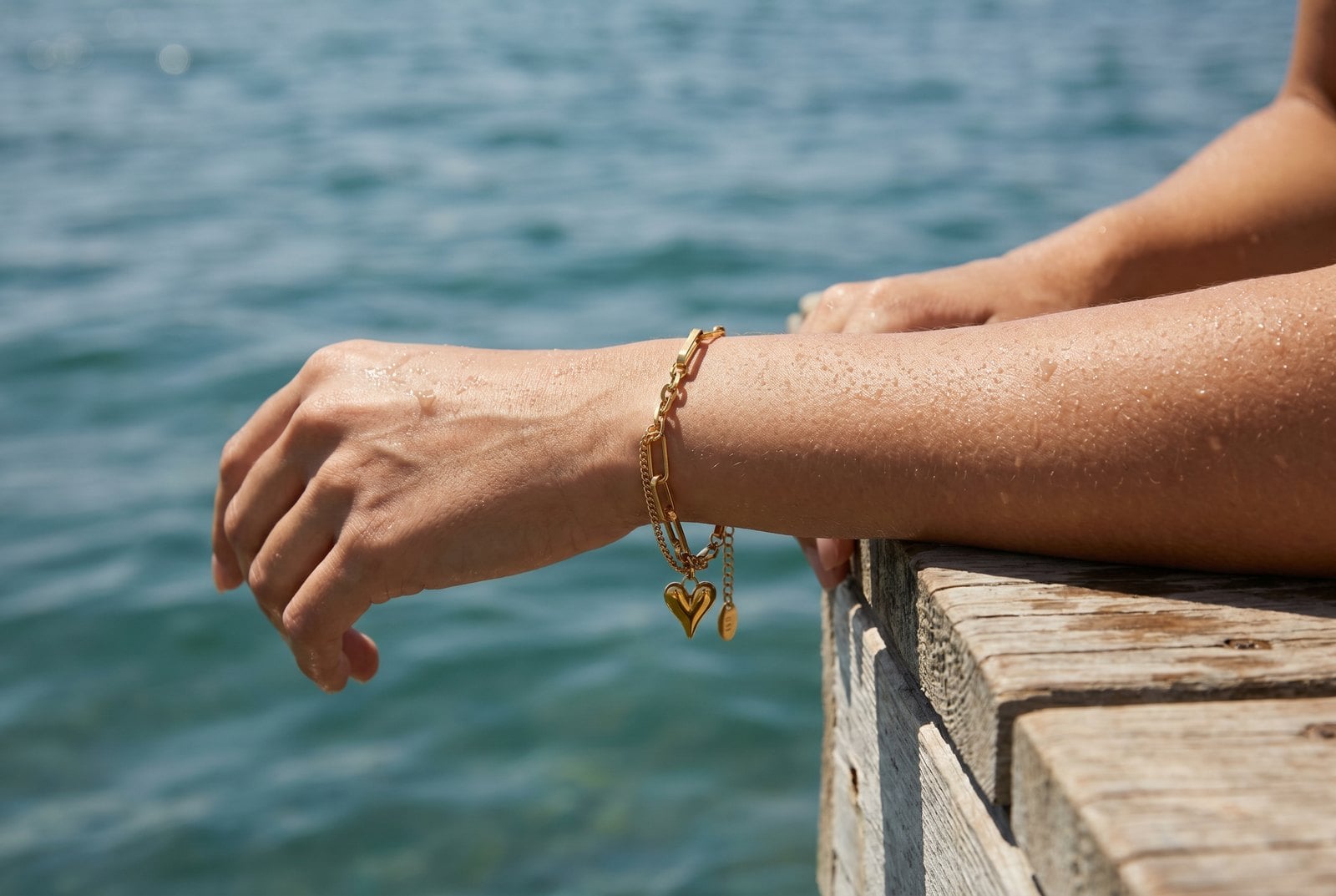
Every Glozya piece is built this way — 18K gold PVD-bonded onto a 316L stainless steel core. That's the construction that earns the *waterproof* label honestly. A daily example is our heart link bracelet, built on that same 316L stainless steel base so it holds up in the shower, pool, and gym. For the full technical breakdown of why we chose this construction over alternatives, see how Glozya jewelry is made and the deeper guide on 316L stainless steel as a hypoallergenic base.
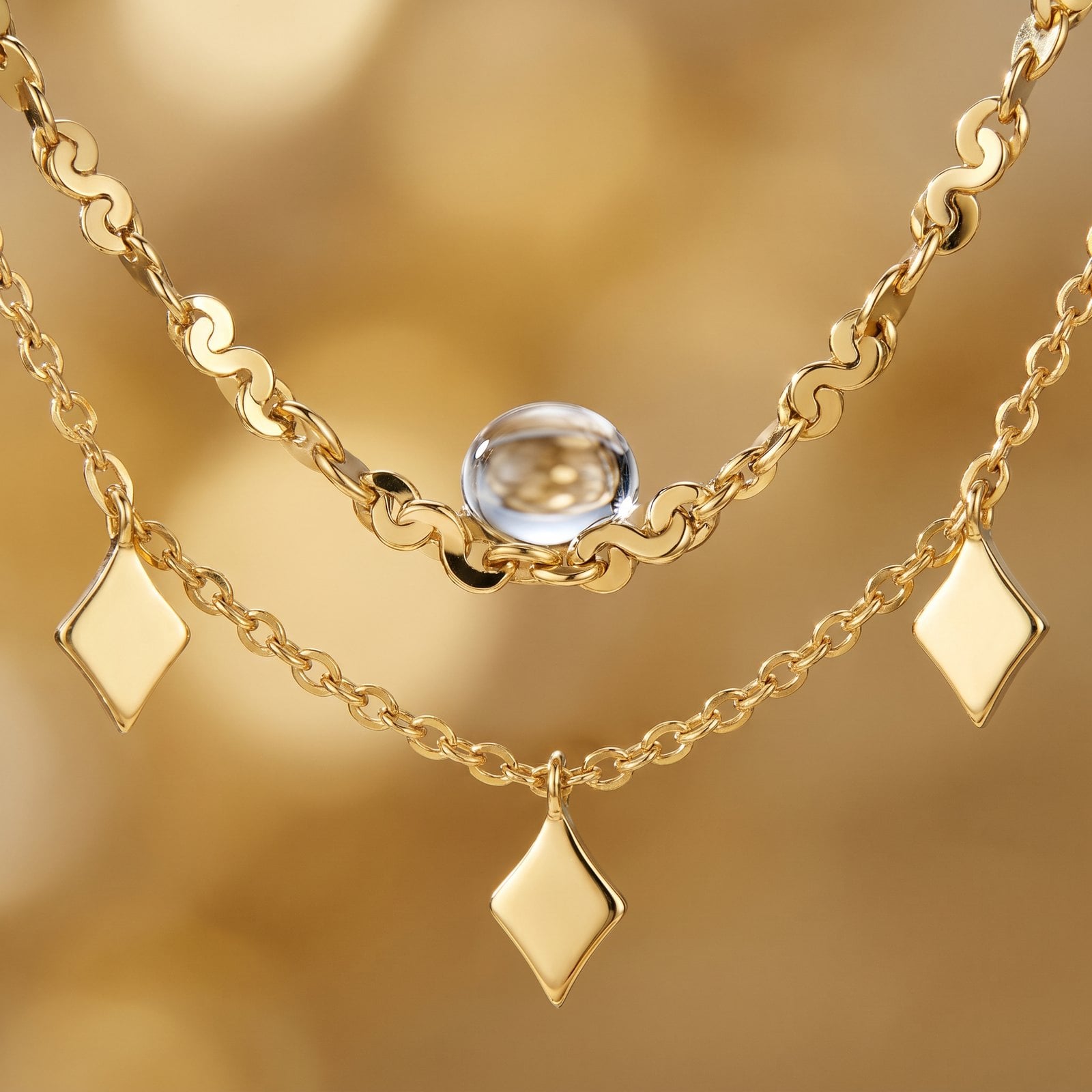
PVD gold doesn't sit on the steel — it fuses with it. That's the difference between two months of plating and two years of plating.
— The Glozya Journal
Scenario Tests — Real-World Pass and Fail
The table above gives the summary. This section gives the why behind each rating, ranked roughly from least to most damaging.
Showers, Chlorinated Pools, and Hot Tubs
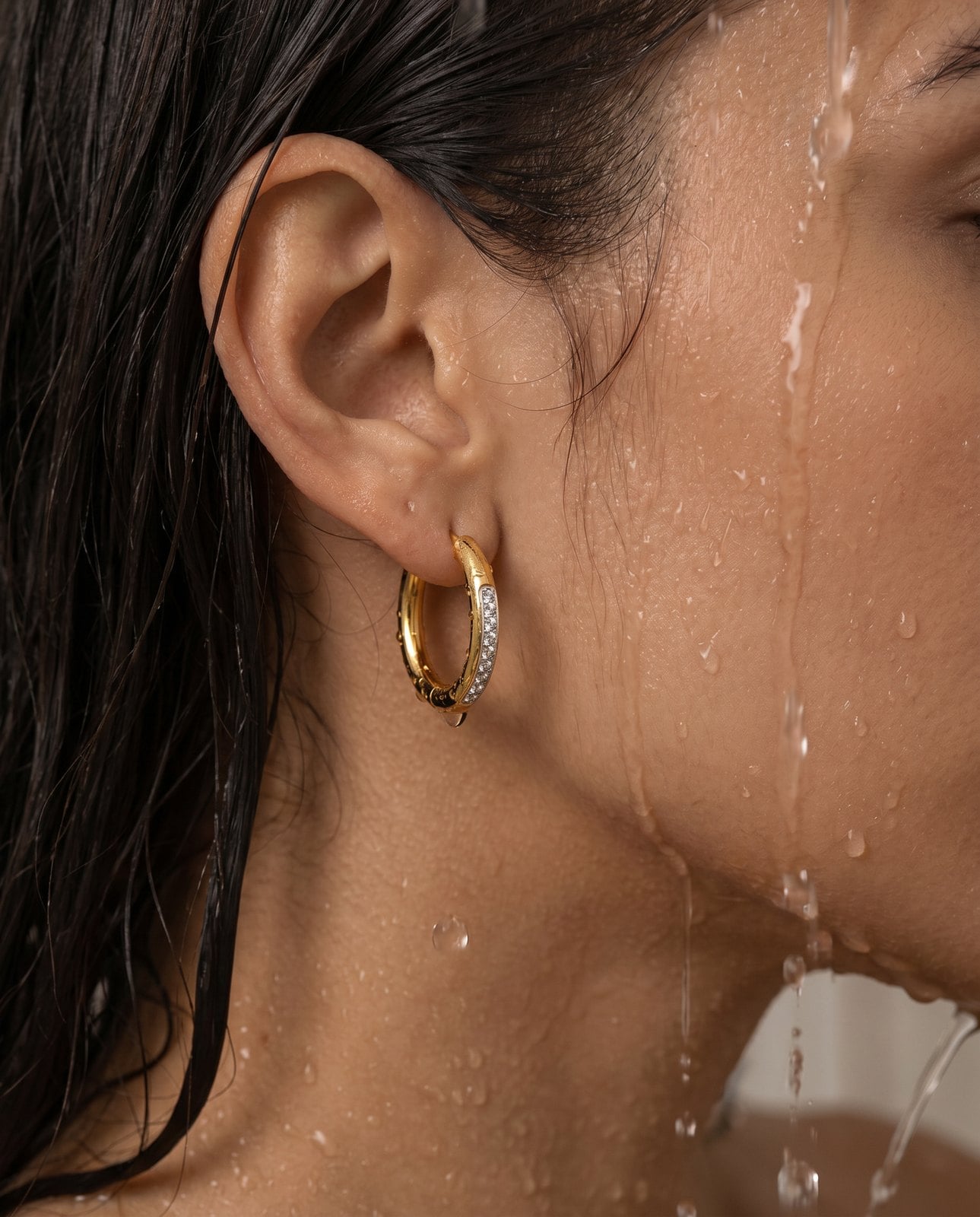
A typical Canadian shower exposes jewelry to warm water, shampoo, and conditioner residue for about ten minutes. For solid gold and quality PVD-plated stainless steel, this is a non-event. For electroplated brass, the cumulative effect of soap residue and warm water erodes the plating within months — the plating doesn't dissolve, but the soap film leaves residue at wear points that abrades the gold layer faster.
Chlorinated pools are harsher because chlorine actively bleaches the alloy metals in plating. A typical Canadian community pool runs chlorine at 1-3 ppm; an hour of swimming is fine for solid gold but accelerates plating wear on cheaper pieces. Hot tubs are the single worst exposure for any plated jewelry because chlorine concentration is typically 3-5x higher than pools, the temperature is elevated above 38°C, and water sits against skin (and jewelry) for the full session. Even quality PVD plating slides into caution territory in repeated hot-tub use.
Saltwater, Sweat, and the Gym
Saltwater corrodes most plated jewelry but is surprisingly gentle on solid gold and PVD-plated stainless steel. The salt itself isn't reactive with gold; the issue is salt residue left to crystallize on clasps and chain links after the water evaporates. A quick freshwater rinse after ocean swimming neutralizes this almost entirely.
Sweat is a slow-burn problem rather than a single-event one. Human sweat is mildly acidic (pH 4.5-7.0) and contains chloride salts. Wearing jewelry for a workout is fine; wearing it for multiple workouts without rinsing between them allows salts to concentrate at clasps and on the back side of pendants where they contact skin. For daily gym-goers, the lifespan-extending habit is rinsing pieces under tap water after sessions, not removing them entirely.
Sunscreen, Lotion, and Hand Sanitizer
This is the category most other guides skip. Modern sunscreens contain titanium dioxide, zinc oxide, and avobenzone, all of which leave residue on jewelry surfaces. They don't actively corrode plating but the residue dulls gold finishes within weeks if not cleaned. The fix is sequencing: apply sunscreen, lotion, and perfume before putting jewelry on, and let everything dry.
Hand sanitizer is the surprising hazard here. The 70% alcohol content can dissolve adhesives used in some pavé and gemstone settings, and the repeated drying action concentrates any residual oils on the metal. For solid gold and PVD plating, occasional contact is fine; daily heavy sanitizer use (common for healthcare workers) shortens the visible lifespan of plated finishes by months.
Canadian Conditions — Winter Salt, Cold, and Coastal Humidity
Most waterproof-jewelry guides are written for US or European climates. Canadian conditions add three failure modes that don't appear in US guides: winter road salt brine, sub-zero metal contraction, and coastal humidity in BC and the Maritimes.
Winter road salt is calcium chloride or sodium chloride brine that coats every surface from November through March in most Canadian provinces. It's far harsher than ocean saltwater because the concentration is higher and it's combined with road grime. For plated jewelry, glove-friendly bracelets and rings get the most exposure when you grip salty steering wheels and door handles. The fix is the same as for saltwater: rinse, don't wipe with a dry cloth that grinds salt crystals into the finish.
Sub-zero cold causes minor thermal contraction in plating layers. Quality PVD bonding has no visible effect from this; cheaper electroplated pieces can develop micro-cracks at the layer boundary that aren't visible until water gets in and accelerates failure. The practical rule: if you wear jewelry outdoors below -20°C, choose solid gold or quality PVD-plated stainless steel.
Coastal humidity (Vancouver Island, Halifax, St. John's) creates a low-grade constant salt-air exposure that gradually attacks soft-plating finishes. Inland Prairie air is much gentler. Vancouver-based wearers should plan for shorter plated-piece lifespans than Toronto or Calgary wearers, all else equal.
How to Make Waterproof Jewelry Last Even Longer
Even genuinely waterproof jewelry has a longer lifespan with the basic habits below. None of these change whether the piece is waterproof; they reduce cumulative residue buildup that gradually dulls finishes. For the full version of this routine, see how to make gold plated jewelry last longer.
- Apply lotion, perfume, sunscreen, and hair products before putting jewelry on. Let everything dry for a minute.
- Rinse pieces under tap water after pool, ocean, hot tub, or heavy workout sessions. No soap needed — plain water removes the salts and chemicals.
- Pat dry with a soft cloth before storing. Don't rub aggressively; pat.
- Store pieces separately. Even waterproof finishes scratch each other when stacked in a single drawer.
- Check clasps monthly. Spring-ring clasps lose tension over 6-18 months; replacing or tightening a clasp early prevents lost pieces.
- For an annual deep clean, soak pieces (except pearls, opals, or porous gems) in lukewarm water with a single drop of mild dish soap for two to three minutes, then rinse and pat dry.
Signs Your Waterproof Jewelry Is Actually Failing
Waterproof jewelry rarely fails dramatically. The signs are subtle and accumulate over months. Catching them early lets you adjust care habits — or, in the case of genuinely failed pieces, decide whether to repair or replace.
- Color shift toward yellow-orange or pink-brown at wear points — the most common early sign on plated pieces. Indicates plating has thinned at high-friction spots (back of rings, link contact points on chains).
- Visible base-metal patches — usually grey, brass-yellow, or copper-pink areas appearing through the gold. By this stage the plating has worn through; the piece is no longer waterproof.
- Dull patches that don't polish out — micro-scratching that traps residue. Soft polishing helps; aggressive polishing accelerates plating loss.
- Green or grey skin discoloration — indicates the base metal is now contacting skin (and reacting with sweat). Common on rings worn through hand sanitizer use.
- Clasp stiffness or looseness — a mechanical failure rather than a finish one. Replace the clasp before losing the piece.
Where to Buy Waterproof Gold Jewelry in Canada
The Canadian waterproof-jewelry market clusters around six brands worth knowing. Each takes a slightly different approach: some use PVD on stainless steel (the most waterproof construction), some use solid gold, and some use higher-end vermeil. Cross-checking against the test matrix above tells you which one matches your daily wear honestly.
- Glozya — 18K gold PVD plating on 316L stainless steel. Hypoallergenic. Designed in Canada, free shipping on Canadian orders $75+. See the full waterproof jewelry collection.
- Jenny Bird — Mix of lightweight steel and solid 14K gold; broad selection of statement pieces. Toronto-based.
- Pilgrim — Danish brand with strong Canadian distribution; PVD gold on stainless steel construction.
- Mia Bijoux (MIAJWL) — Quebec-based; ten-year track record on waterproof stainless steel pieces.
- Sunny Sunday — Smaller Canadian indie; waterproof, sweat-proof, hypoallergenic stainless construction.
- Unsalted Honey — Toronto-based; surgical stainless steel pieces with strong day-to-night styling range.
- Mejuri — Larger Canadian brand; mostly solid gold and gold vermeil rather than PVD plating, so the *waterproof* claim should be checked piece-by-piece.
For wider context on what's trending across Canadian brands right now, see our breakdown of Canadian jewelry trends shaping 2025 — waterproof, hypoallergenic everyday pieces are the dominant category, and the gap between brand promises and real-world performance is wider than ever.
About the Author

Mohammad Aftab is the founder of Glozya, a Canadian 18K gold-plated jewelry brand he launched in 2023. He has over a decade of experience in e-commerce, email marketing, and brand design across DTC, retail, and digital media. He writes about jewelry care, style, and the everyday details that make a piece worth keeping.