Is Stainless Steel Jewelry Hypoallergenic? A Canadian Guide
In this guide
Stainless steel jewelry gets marketed as "hypoallergenic" so consistently that the word has almost lost meaning. Some pieces labeled hypoallergenic still cause reactions. Some pieces without the label are genuinely safe for the most sensitive skin. The difference isn't always about marketing — it's about specific grades of stainless steel, and how nickel is bound inside those grades. This guide gives you the honest answer about whether stainless steel jewelry is hypoallergenic, why the answer has a qualifier, and how Canadian buyers can evaluate a piece before it ends up leaving a red ring around their wrist or earlobes.
The short version is that 316L stainless steel is hypoallergenic for roughly 99% of people, including most people with diagnosed nickel allergies. But the full picture includes the 1% edge case, the difference between steel grades, how reactions actually work, and what to do if you're in the group that reacts even to 316L. For Canadian shoppers specifically, Health Canada treats nickel contact allergy as a real clinical concern, and the rise of stainless-steel-based jewelry in Canada's fashion market is partly a direct response to that.
Is Stainless Steel Jewelry Hypoallergenic?
Stainless steel jewelry is hypoallergenic when it's made from the right grade of stainless steel. The two grades that genuinely qualify as hypoallergenic are 316L (surgical stainless steel) and 304 (food-grade stainless steel), with 316L being the gold standard for jewelry that contacts skin continuously. Lower-grade stainless steel (the 200-series alloys used in cheap jewelry and industrial applications) contains more free nickel and higher rates of nickel leaching. These grades can and do trigger allergic contact dermatitis in sensitive individuals, despite being sold as "stainless steel."
So the accurate statement isn't "stainless steel is hypoallergenic." It's "316L stainless steel is hypoallergenic for the overwhelming majority of people, including most people with diagnosed nickel allergies, while lower grades of stainless steel are not reliably hypoallergenic." That distinction matters when you're buying jewelry, because "stainless steel" on a product page tells you almost nothing — the grade is what determines whether it's actually safe for your skin.
The accurate statement isn't "stainless steel is hypoallergenic." It's "316L stainless steel is hypoallergenic for the overwhelming majority of people."
— The Glozya Journal
316L compatibility
~99%
316L stainless steel is hypoallergenic for roughly 99% of people, including most people with diagnosed nickel allergies.
Nickel sensitivity
10-20%
Health Canada and dermatology research estimate 10-20% of women have some level of nickel sensitivity.
Why Nickel Is the Core Issue
Nickel allergy is one of the most common metal allergies in the general population. Health Canada and dermatology research estimate 10-20% of women and around 2-3% of men have some level of nickel sensitivity. For people with diagnosed nickel allergy, even small amounts of nickel in direct skin contact over hours can trigger allergic contact dermatitis — redness, itching, small blisters, and discoloration around where the jewelry touches.
Here's the complication: 316L stainless steel actually contains nickel. Roughly 10-14% nickel by weight, in fact. That's a higher percentage than many cheap costume jewelry pieces that cause reactions. So why doesn't 316L cause reactions in most nickel-allergic people?
The answer is in how the nickel is bound. In 316L, the nickel is chemically locked into a stable austenitic alloy structure alongside chromium (16-18%) and molybdenum (2-3%). These elements form a protective chromium-rich oxide layer on the surface that prevents nickel from leaching out in significant amounts under normal wear conditions. In contrast, cheap costume jewelry often contains free nickel or loosely bound nickel on the surface, which leaches readily when exposed to sweat, water, or skin contact.
What "316L" Actually Means
316L is a specific industry-standard designation with a specific composition. Understanding it helps you evaluate whether a seller's "316L" claim is legitimate or just marketing.
The composition
316L is an austenitic stainless steel alloy containing approximately:
- Chromium: 16-18% — creates the protective oxide surface layer that prevents corrosion and nickel leaching
- Nickel: 10-14% — bound into the austenitic structure, not free-floating
- Molybdenum: 2-3% — improves corrosion resistance, especially against salt water and sweat chlorides
- Carbon: max 0.03% — the "L" in 316L stands for "low carbon," which is important for weldability and corrosion resistance at grain boundaries
- Iron: ~65-70% — the remainder of the alloy
The reason medical implants, surgical tools, and body piercings use 316L specifically is that its composition is stable enough to live inside the human body without causing adverse reactions for most patients. That level of biocompatibility is what makes 316L the gold standard for jewelry worn against skin continuously.
316L vs 304
304 is a closely related austenitic stainless steel with slightly less molybdenum (or none) and slightly more carbon. 304 is also considered hypoallergenic and is used widely in food service, kitchen equipment, and some jewelry. The practical differences for jewelry wear are:
- 304 is slightly more susceptible to corrosion in salt water environments (beach, ocean swimming)
- 316L is slightly more resistant to chloride exposure (sweat, pool water)
- Both are hypoallergenic for the vast majority of wearers
- 316L is the safer specification for body-contact jewelry meant for continuous daily wear
Grades to avoid
Stainless steel grades you want to avoid in jewelry against your skin:
- 200-series (201, 202) — higher manganese, lower nickel stability. Common in cheap costume jewelry. Not reliably hypoallergenic
- 400-series (430, 410) — ferritic or martensitic structures, different properties, not typically used for body jewelry
- Unspecified "stainless steel" — if a seller doesn't specify the grade, assume it's the cheapest available, which is usually 200-series
Every piece in the Glozya catalog uses 316L hypoallergenic stainless steel as the base metal, specifically because Canadian buyers have sensitive skin and we wanted to build around the format that reliably works rather than gamble with cheaper grades.
| Grade | Hypoallergenic reliability | Best use | Glozya take |
|---|---|---|---|
| 316L stainless steel | Highest | Continuous skin-contact jewelry, body jewelry, waterproof daily wear | Best choice for necklaces, bracelets, earrings, rings, and sensitive skin |
| 304 stainless steel | High | Food-grade applications and some jewelry | Generally safe, but less ideal than 316L for sweat and salt exposure |
| 200-series stainless steel | Low | Cheap costume jewelry and industrial applications | Avoid for skin-contact jewelry if you have sensitivity |
| 400-series stainless steel | Variable | Industrial uses, tools, non-body-contact applications | Not the preferred choice for hypoallergenic jewelry |
| Unspecified stainless steel | Unknown | Depends entirely on the seller's sourcing | Treat as a red flag unless the seller confirms the grade |
Why Stainless Steel Reactions Still Happen
If 316L is so reliably hypoallergenic, why do some people still report reactions to stainless steel jewelry? Three specific reasons, each solvable.
Reason 1: The steel isn't actually 316L
This is the most common explanation. A piece is marketed as "stainless steel" without specifying grade, and the actual material is 200-series or lower-quality steel with more free nickel. The seller either doesn't know or doesn't distinguish. If a Canadian retailer can't tell you specifically "316L" when you ask about their stainless steel jewelry's composition, assume it's not.
Reason 2: The reaction is to the plating, not the steel
Many stainless steel jewelry pieces are plated with gold, rose gold, or silver-tone finishes. If that plating is brass-based or contains free nickel (which happens in cheap plating processes), the wearer can react to the plating even though the underlying steel is legitimately hypoallergenic. This is why quality 18K gold plating over 316L is the safest combination — both the base metal and the plating are skin-safe.
For more on how plating quality specifically affects skin safety, see our guide on what 18K gold plated jewelry really is, and the 14K vs 18K comparison.
Reason 3: True severe nickel hypersensitivity
A small percentage of people — roughly 1% of the nickel-allergic population — have reactions severe enough that even the trace amounts of nickel leaching from 316L trigger symptoms. For these individuals, 316L isn't sufficient. They need genuinely nickel-free metals: titanium (medical-grade), niobium, or high-purity gold (14K+ solid). This is a real edge case worth acknowledging, but it's a small minority of even the nickel-allergic population.
If you've been reacting to multiple pieces of jewelry including 316L stainless steel and medical-grade earring posts, it's worth seeing a dermatologist for a patch test. The diagnosis matters because it determines whether you need to avoid all nickel-containing metals or just the lower grades.
How Reactions Actually Show Up
Knowing how an allergic reaction to metal jewelry presents helps you identify whether a piece is the problem. Contact dermatitis from nickel-containing jewelry typically shows up within hours to a day of contact and resolves within 1-3 weeks of removing the source.
Common presentations:
- Redness and itching around where the jewelry touches skin — not diffuse across the body
- Small bumps or blisters at contact points, particularly around earlobes with earrings or under watch backs and ring bands
- Dry, flaky, or discolored skin with repeated exposure — the skin develops a chronic irritation pattern
- Green or black marks on skin under jewelry — usually indicates the base metal is brass or copper, not stainless steel (real 316L doesn't leave green marks)
- Burning or stinging sensation especially with new jewelry or after workouts when sweat amplifies exposure
Any jewelry causing green marks is failing a basic material quality test.
How to Verify a Seller's 316L Claim
Most jewelry sellers don't show grade certifications, so evaluation often comes down to secondary signals. Here's how to assess whether a seller is legitimate about their 316L claim.
- Look for specific grade terminology. Sellers who actually use 316L will use the term "316L," "surgical stainless steel," or "medical-grade stainless steel" in product descriptions. Sellers who use vague "stainless steel" or "hypoallergenic metal" without specifics are often using cheaper grades.
- Check for consistent composition disclosure. Quality brands disclose base metal across their entire catalog, not just on a select few pieces. If a brand's product pages sometimes say "316L" and sometimes just say "metal alloy," the 316L claim likely only applies to specific pieces.
- Look for hypoallergenic guarantees. Reputable brands back their 316L claim with a satisfaction guarantee that covers skin reactions. If a brand won't accept returns for reactions, they're not confident in their own material.
- Read reviews specifically from sensitive-skin customers. Reviews from people mentioning nickel allergy or eczema and reporting no reactions are strong signals. A single review isn't definitive; look for a pattern across many reviews.
- Check for waterproof claims. This is an indirect signal — pieces genuinely built on 316L are naturally waterproof because the base metal doesn't rust or corrode. Brands that market waterproof as a standard feature are generally building on higher-quality base metals. Brands that warn against water exposure are usually using reactive base metals like brass.
Every piece across bracelets, earrings, necklaces, and finger rings at Glozya is 316L stainless steel with 18K gold plating, waterproof, and backed by a skin-safety guarantee. For the full story on what *waterproof* actually means at the material level — and which scenarios real-world Canadian wear punishes hardest — see our waterproof gold jewelry guide.
Why This Matters More in Canada
Canadian buyers encounter a specific version of the stainless steel hypoallergenic question that's different from US or UK buyers. Several factors make nickel sensitivity a more significant concern in the Canadian market.
- Higher overall nickel sensitivity rates. Studies suggest Canadian women have nickel allergy rates at the high end of the global range — possibly due to piercing practices, climate, or dietary nickel intake. The practical effect is that more Canadian shoppers need to filter jewelry by skin safety first.
- Climate that amplifies reactions. Cold Canadian winters cause dry, compromised skin that reacts more readily to metal contact. Humid summers cause sweat exposure that leaches nickel from reactive base metals faster. Both extremes make skin-safety a year-round concern in Canada, not a seasonal one.
- Heavy daily jewelry wear patterns. Canadian fashion trends toward layered chains, stacked bracelets, and multiple earrings per ear means more metal-to-skin contact surface area per person. More contact = more cumulative exposure to any nickel leaching.
- Growing market demand for truly hypoallergenic options. Canadian direct-to-consumer jewelry brands have responded to this by building around 316L stainless steel as the default base. US and UK markets still have many fashion brands using brass as the primary base; Canadian DTC brands have moved faster toward stainless steel specifically because Canadian customers demand it.
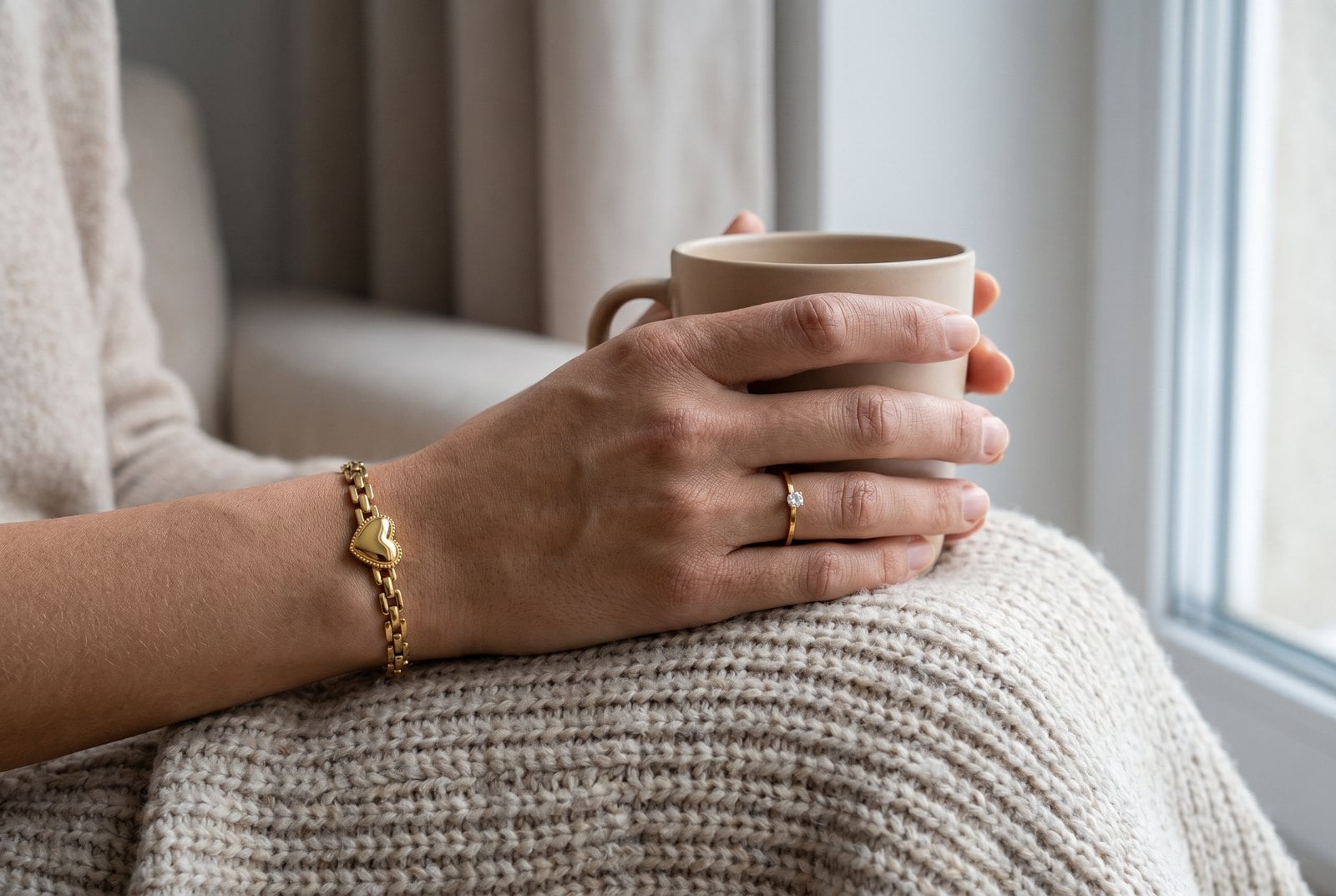
For trend context on why the Canadian market is moving this direction, see our companion piece on Canadian jewelry trends.
Practical Buying Checklist for Sensitive Skin
If you're shopping for jewelry with known skin sensitivity or a history of reactions, here's the order of checks that reliably produces a safe purchase.
- Verify the base metal specifically. Look for "316L," "surgical stainless steel," or "medical-grade stainless steel" — not just "stainless steel"
- Verify the plating if any. Quality 18K gold plating over 316L is the safest plated combination. Avoid "gold-tone" finishes over unspecified bases
- Check for hypoallergenic guarantee. A brand confident in their material will accept returns for reactions
- Look for waterproof construction. Genuine 316L-based pieces are naturally waterproof; brands that say "avoid water" usually have reactive base metals
- Start with a small piece. If you're trying a new brand, buy one piece first. Wear it for a week. If no reaction, the brand is safe for your skin and you can buy more
- Pay attention to clasps and posts. Sometimes the main piece is 316L but the clasp or earring post is a cheaper alloy. Quality brands use 316L or titanium throughout, not just in the visible portion
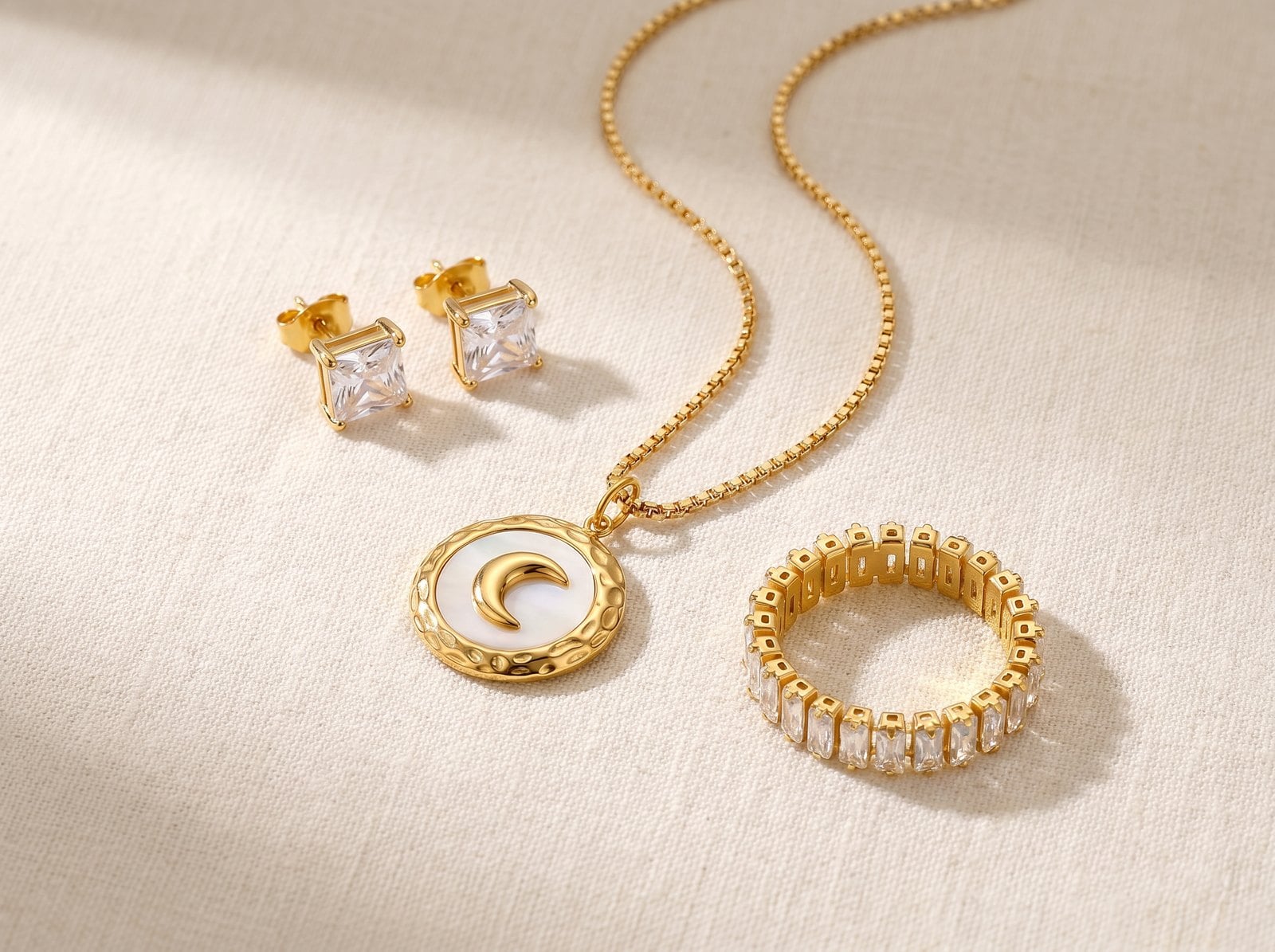
For the full picture on how stainless-steel-based pieces compare to other jewelry categories (gold filled, gold plated, vermeil, solid gold), see our guide on gold plated vs gold filled vs solid gold. For daily-wear care that extends the life of any piece, see our guide on making gold plated jewelry last longer.
What to Do If You Still React
If you've tried legitimate 316L pieces and still have reactions, the next steps depend on what the reaction looks like and how severe it is.
- Mild, localized reactions: Try a piece with a barrier — a clear nail polish coating on the back of the piece, or a silicone backing on earring posts. This doesn't solve the underlying issue but can make specific pieces wearable.
- Persistent reactions across multiple pieces: Move to genuinely nickel-free metals — titanium (medical grade), niobium, or solid 14K+ gold. These are more expensive but bypass nickel entirely.
- Severe or spreading reactions: See a dermatologist for a patch test to confirm what you're actually reacting to. Sometimes what looks like metal allergy is actually a reaction to plating chemistry, fragrance residue, soap buildup, or a pre-existing skin condition. Diagnosis determines treatment.
- Sudden reactions to previously tolerated pieces: Nickel sensitivity can develop over time, especially with repeated exposure. A piece you've worn comfortably for years might suddenly start causing issues. If this happens, it's a sign to migrate your daily-wear pieces to 316L or higher-tier options.
Browse new releases for the latest Glozya arrivals, check the current flash sale for discounted pieces, or explore by category: bracelets, earrings, necklaces, and adjustable rings. Every piece is 316L stainless steel with 18K gold plating, waterproof, and ships free across Canada on orders over $75.
About the Author

Mohammad Aftab is the founder of Glozya, a Canadian 18K gold-plated jewelry brand he launched in 2023. He has over a decade of experience in e-commerce, email marketing, and brand design across DTC, retail, and digital media. He writes about jewelry care, style, and the everyday details that make a piece worth keeping.